How Robots are Shaking Up NDT Inspections within the Offshore Oil & Gas Industry
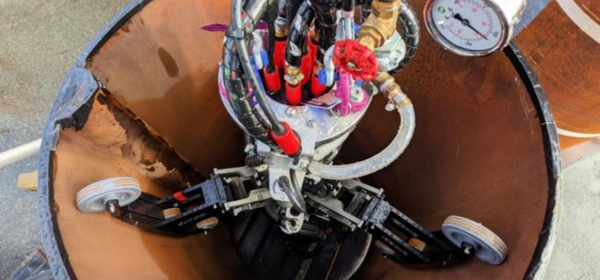
NDT inspections present challenges in all industries. However, this is particularly relevant in regard to offshore oil & gas. Thankfully, recent leaps in technology have managed to automate many tasks.
While many maintenance teams have been hesitant to embrace robotic systems when they were in their infancy, today’s cutting-edge tech is streamlining many traditional processes. From pipe inspections to imaging cameras, the days of laborious and high-cost shutdowns in order to carry out vital testing are numbered. Robots are crawling, climbing and flying their way through such tasks, transporting a variety of NDT equipment to carry out tests in even the most challenging of places.
Introducing the Robots
One of the greatest advantages of robots is that many of them can be customised to carry a wide variety of NDT testing equipment. Need UT testing and video surveillance in a hard-to-access cylindrical asset? Many robotic crawler tractors can easily be fitted with the equipment to access the location and carry out the task.
Tank shell inspections can be performed in a fraction of the time it would take a human inspector. Examples of how this is successfully implemented include remotely operating an ultrasonic crawler, such as the Scorpion 2. Robotic crawlers can also work above, at or below the splash zone, meaning corrosion testers and probes – including pulsed eddy current – can be attached, allowing readings to be taken and documented with no risk to human personnel.
Visual inspections form the backbone of many testing services. Here, the use of a variety of robots can upscale these tasks, especially in the case of hard or dangerous-to-access areas. Drones are particularly useful in carrying out RVI without having to physically get eyes on the surface. The Zenith for instance with a 500+ foot reach, 360 degree viewing thanks to a specialized gimbal and CoaxDrive, can record 4k video, 18MP stills and has an 18x optical zoom for internal inspection of assets.
The Benefits of Robotic Systems
Within the offshore industry, mandatory testing brings many challenges. These can be briefly summed up as:
- Often require personnel to work in high-risk situations. These include at height, close to, at, or below the splash zone, in inclement weather conditions, enclosed spaces, and around toxic substances.
- Testing is time-consuming and expensive – assets need to be shut down in many cases. Specialist teams often need to be contracted to carry out tasks or staff need to be trained to carry them out.
- The complexity of the majority of NDT means pro-active testing (over and above mandatory levels) has rarely been considered an option.
Using robotic systems to shoulder many testing requirements positively impacts all of these areas.
- Robots remove a high element of risk. Remote operation and the introduction of semi-autonomous appliances make for far safer testing processes.
- Robots can enter toxic or non-oxygen environments.
- Robotic system testing is often much faster than its manual counterpart. This means assets are offline for a dramatically shorter period.
- Testing that’s faster, safer and cheaper means that maintenance managers can consider putting proactive maintenance in place.
The latter brings a multitude of advantages, the most valuable being that of predictive maintenance. With increased testing data, it becomes far easier to accurately predict the MTBF for assets. In addition, maintenance and repair work can be scheduled far in advance, so amalgamating similar works across a platform.
Nexxis has long championed advancing technology and is at the forefront of cutting-edge equipment that helps streamline NDT needs, improve accuracy, reduce costs and increase safety.
We follow a bespoke approach for all client needs, combining the best solution for even the most complex of testing issues.
Contact us to find out more about our range of scanners or any of our other NDT products, or request a quote online.
Carry on reading Is Proactive NDT Inspection the Key to Great Asset Management? to find out more.

Jason De Silveira, founder and CEO of Nexxis Technology, has always had a sharp focus on robotics, education, and real-world solutions. Throughout his career, he’s stayed committed to pushing the boundaries of robotics and helping industries strengthen their approach to asset integrity and robotic inspection.
With a background in operations, commissioning, and start-ups of new facilities, Jason leads Nexxis with a hands-on understanding of what real projects demand. Under his leadership, Nexxis has become known for developing innovative robotic systems that deliver better data, boost safety, and take the risks out of confined space and working-at-height inspections.
What makes Jason stand out? A passion for innovation, a proven ability to bring people together, and a genuine drive to help clients get the right solution — not just an off-the-shelf fix. With a strong focus on customisation and future-ready technology, he’s helping to shape the next generation of robotics.